
Top 5 AI sales coaching platforms for field sales
Doorstep and in-home selling do not happen in a controlled call. We compared the systems that prepare a rep before the visit, capture what happened during it, and help managers change what happens next.
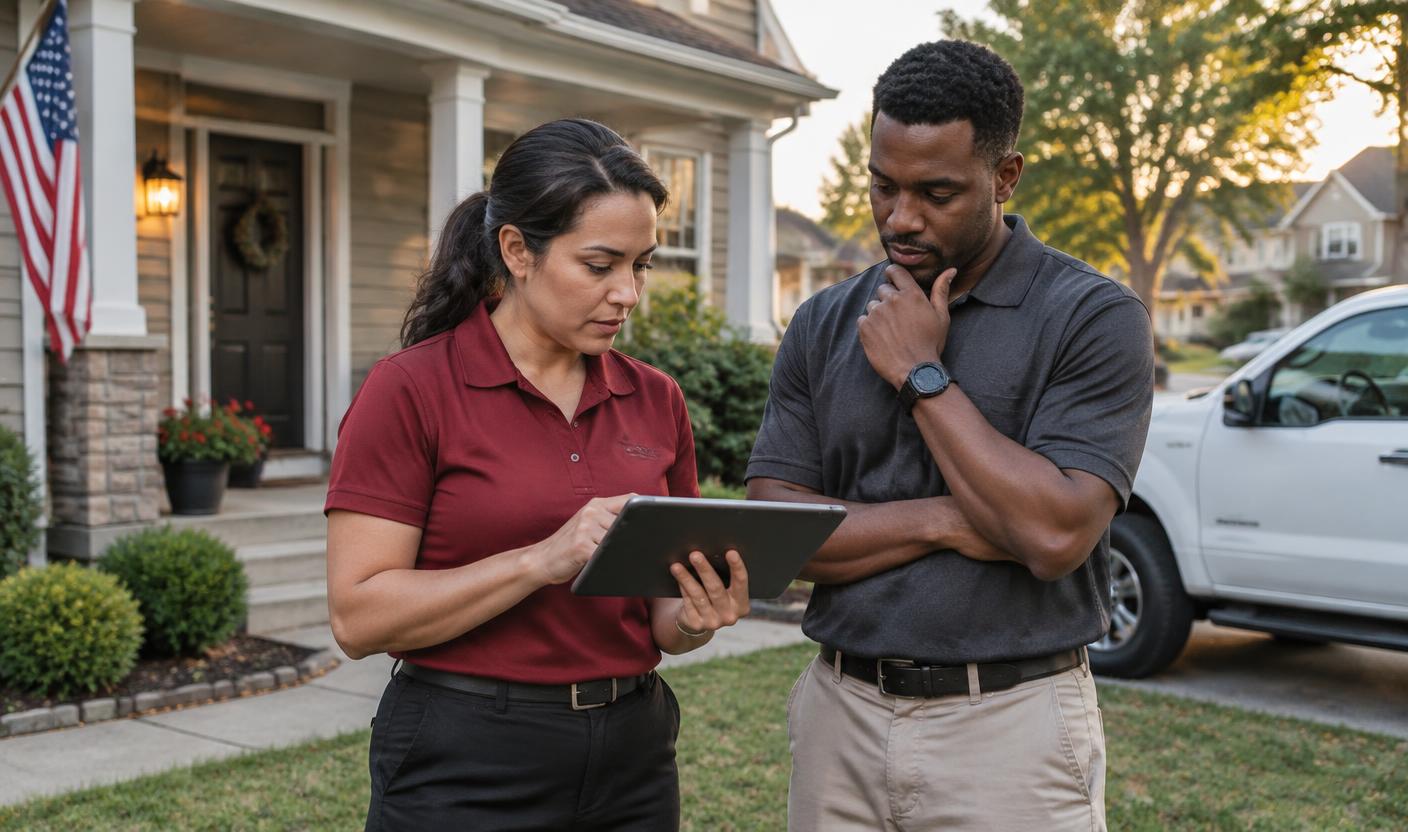
Field sales is not inside sales with worse Wi-Fi. A home-improvement consultant may move from a kitchen-table presentation to a noisy driveway, while a door-to-door rep may hear no forty times before a serious buyer opens the next door. There is no neat meeting link, reliable microphone or manager silently observing every exchange. The coaching problem includes recovery, presence and judgment as much as talk ratio.
That makes the category unusually easy to misunderstand. Some tools rehearse the conversation before a rep meets a customer. Others record the real appointment and grade it afterwards. A third group manages territories, activity and leaderboards, then connects to a conversation product. All can improve coaching, but they do not do the same job.
Our ranking gives the greatest weight to whether a product closes the coaching loop: prepare, observe, diagnose, practise and improve. It is not a ranking by company size. Rilla has much stronger public evidence of market scale than Practis; Practis ranks first because its readiness model is the most complete match for field coaching as we define it. Buyers who primarily need recorded ride-alongs should choose differently.
| Platform | Best for | Model | Price signal |
|---|---|---|---|
| 1. Practis | Readiness, roleplay and certification before the customer visit | Practice-first | Custom quote |
| 2. Rilla | Large home-services teams needing virtual ride-alongs | Capture-first | Custom annual contract; third-party reports indicate premium pricing |
| 3. Siro | Field-call analytics and home-services workflows | Capture-first | Custom annual contract |
| 4. Second Nature | Multilingual enterprise simulation and standardization | Practice-first | Custom enterprise quote |
| 5. SalesRabbit with Siro | Field activity management plus conversation coaching | Field operations + capture | Two-product cost; quote both layers |
1. Practis
Best for preparing and certifying the performer before a live lead
Practis starts before the customer opens the door. Reps rehearse against an AI buyer, receive structured feedback and work toward readiness or certification. For distributed roofing, solar, pest-control, telecom, insurance and home-services teams, that is a meaningful distinction: the business can discover a weak skill before it spends a live lead on the lesson.
The attached PRACTIS™ Method gives the product a clearer theory of field performance than most roleplay platforms publish. Its seven-stage loop—Presence, Reveal, Agency, Clarify, Truth, Invite and Score—is observed through nine dimensions: Inner Game, Human, Trust, Information, Tactical, Competitive, Score, Learning and Long Game. In plain English, it asks more than whether a rep recited the approved line. It considers composure, buyer autonomy, truthful claims, discovery, the ask, learning and the durability of the customer relationship.
That is especially relevant late in a field day. A rep may know the script at door four and lose the ability to execute it at door thirty-nine. Practis treats each interaction as input to the next, and its published ethics language requires transparency, verifiable claims and a real right to say no. Those are strong design principles for high-pressure residential selling.
The evidence boundary is equally important. Practis publishes impressive performance claims on its own product pages, but we found less independent review and market-scale evidence than for Rilla or Siro. The methodology itself says its outcome claims are hypotheses entering field validation. We therefore rank Practis first for fit and coaching design—not for proven category scale. Require a controlled pilot, manager calibration and customer references from your trade before committing.
The clearest practice-to-certification model for field performance, with no homeowner recording required for simulated practice.
Custom pricing and thinner independent evidence. Verify that readiness scores predict your own field outcomes.
2. Rilla
Best for large home-services teams that need to see what happened
Rilla helped establish the virtual ride-along as a serious field-sales category. Its mobile workflow records in-person appointments, transcribes them and scores the conversation against a company playbook. For a multi-branch HVAC, roofing or windows business, that can replace a tiny sample of physical ride-alongs with a much wider view of what customers actually hear.
Rilla has the strongest public signal of commercial scale in this group. Sacra estimatessubstantial revenue and reports more than 2,000 accounts; those remain third-party estimates, but they are materially stronger market evidence than a vendor testimonial alone. Rilla has also moved toward real-time assistance through Rilla Live.
Its weakness is structural. Capture shows what happened; it does not automatically create deliberate practice before the next appointment. The product can also be expensive. Rilla does not publish a standard rate card, while third-party reports describe annual commitments, seat minimums and setup charges. Treat every online dollar figure as a benchmark, not a quote, and ask for the complete first-year cost in writing.
Best evidence: market adoption · Main risk: cost and post-call overload
3. Siro
Best for field-call analytics and home-services workflows
Siroalso records and analyzes in-person conversations, with AI scorecards, coachable moments and workflows aimed directly at home services and home improvement. Its integration with ServiceTitan gives it a practical advantage for contractors that already run sales operations there.
Siro is the better demo when your question is not simply “did the appointment record?” but “which moments deserve a manager’s attention?” Its product material emphasizes deeper analysis, rehash opportunities and coaching signals. As with Rilla, the real test is a week of noisy driveways, long appointments and uneven cellular coverage—not a clean conference-room demonstration.
Pricing is quote-led. Third-party estimates place it in the same broad premium category as Rilla, but figures vary and should not be treated as vendor-confirmed. Siro also shares the core limitation of capture-first systems: unless managers convert the findings into focused rehearsal, the company can accumulate a sophisticated archive of mistakes without changing the next conversation.
Best evidence: field specialization and workflow · Main risk: insight without practice
4. Second Nature
Best for multilingual enterprise roleplay and controlled rollout
Second Natureis not a field-capture tool. It earns a place because large field organizations still need scalable practice before reps work alone. The platform supports AI simulations, scenario administration, enterprise integrations and more than 25 languages, according to the vendor. It also publishes a mature security and privacy posture for global programs.
This is the strongest fit for a national or multinational company that needs one product-launch simulation delivered consistently across regions. The trade-off is specificity: Second Nature is a broad enterprise simulator rather than a system built around the emotional and physical rhythm of door-to-door work. The buyer has to supply the field context and prove that performance transfers beyond the avatar.
Best evidence: enterprise controls and language coverage · Main risk: not field-native
5. SalesRabbit with Siro
Best when coaching must sit inside territory and activity management
SalesRabbit Amplify is frequently described as coaching software, but the distinction matters: its native strength is field CRM, activity analytics and gamification rather than AI evaluation of a customer conversation. For conversation coaching, SalesRabbit has a published integration with Siro.
The combined stack belongs here because field performance is not only what a rep says. Territory coverage, follow-up, activity and consistency also matter. Teams already standardized on SalesRabbit can start a Siro recording within that workflow and connect conversation evidence to field execution.
This is not a one-vendor answer. Buyers must price, administer and govern two products, and leaderboards can reward visible activity rather than customer value if incentives are poorly designed. We would not buy Amplify alone for AI coaching; we would evaluate the combination when replacing the field CRM is off the table.
Best evidence: native field workflow · Main risk: two-product cost and complexity
Recording a kitchen-table sale changes the risk
A roleplay records an employee practising with software. A virtual ride-along records a real homeowner inside or near a home. Those are not equivalent privacy events. US recording law varies by state, and multi-state teams cannot safely reduce the issue to the federal one-party-consent floor.
Siro’s own recording guiderecommends disclosure and verbal consent. That is the sound operating baseline everywhere, even when a state may permit less. Buyers should also define access, retention, deletion, rep notice, customer requests and whether an automated score can affect pay or employment. Have counsel review the actual workflow in every state where the team operates.
Test the driveway, not the demo room
- Define one costly behavior. Use a specific failure such as weak financing disclosure or failure to clarify the homeowner’s real concern.
- Establish a human baseline. Two experienced managers should independently score the same samples before seeing AI scores.
- Use representative conditions. Include accents, interruptions, poor reception, long appointments and end-of-day fatigue.
- Measure transfer. A practice score matters only if the next real interaction improves; a recording score matters only if the next rehearsal targets it.
- Track manager minutes. Count calibration, review and scenario maintenance. Software that creates another inbox has not solved coaching capacity.
- Price the whole year. Include minimum seats, implementation, integrations, storage, support and the second product where a stack is required.
Buy the missing part of your coaching loop.
Choose Practis when the urgent problem is readiness before a rep meets the buyer. Choose Rilla when manager visibility across many in-home appointments is the priority. Choose Siro when field analytics and home-services workflow matter most. Choose Second Nature for multilingual enterprise rehearsal. Choose SalesRabbit with Siro when coaching must live inside an existing territory-management system. The best stack may combine practice before the visit with consensual capture after it—but only when each layer earns its cost.
Capabilities were checked against current vendor product pages on 26 September 2026. Market-scale and price signals are labeled where they come from third parties and should be verified in a written quote. Practis methodology detail comes from the company’s published PRACTIS™ Method supplied with this assignment; its own validation caveat is included above. No vendor paid for inclusion, reviewed this ranking or supplied an affiliate link. We did not deploy all five systems inside one controlled field organization.
Primary references: Practis · PRACTIS™ Method · Rilla · Siro · Second Nature · SalesRabbit–Siro integration. Read our editorial standards and corrections policy →